Click for Translation


Showing posts with label Peru Peak 2010. Show all posts
Showing posts with label Peru Peak 2010. Show all posts
Saturday, August 21, 2010


Tuesday, August 10, 2010
Huantsan Expedition's Report
2 New routes opened on Huantsan Mountain (Peru - Cordillera Blanca)
 |
| View from Huantsan South Summit - Cordillera Blanca Range - by Sophie Denis |

o New route in Huantsan West Summit : “Les Trois Mousquetaires”
Sophie is the first woman to summit Huantsan West.
o New route in Huantsan North Summit : “Illusion”
Sophie is the first woman to summit Huantsan North.
HUANTSAN EXPEDITION'S JOURNAL
Sophie Denis I Aug. 5th 2010

 Cut in a storm, we decided to set up our Base Camp at the same place where the car dropped us off.
 July 19th - Base Camp to Advanced Base Camp
After a short walk towards the Moraine of Huantsan North, we found a cozy* camping spot. We set up there our Advanced Base Camp ~4,600m.
* cozy = flat place, not too exposed to wind and with easy access to water.


We packed up and started off at 9:00 am. We walked on the Moraine for ~2h.
It was a short and pretty straightforward approach to the Glacier, at the exception that we had to be vigilant to potential ice falls. We saw an impressive one, crashing on our way, leaving behind giant pieces of blue ice.
The good conditions of the glacier at the beginning allowed us to walk pretty fast. Then, it turned ugly. The snow became deep and very soft, which slowed us down by a lot.
Crevasses got more frequent, got wider, higher, and much more difficult to cross. Toward the end of day, we had to jump over few deep crevasse and it was not much fun.
Early evening, as we were still walking on the glacier, we could see a snow storm coming. So we decided to stop

as soon as we found a camping spot.
We found a cozy* camping spot next to a giant crevasse, which would act as a fence in case of avalanche.
We set up our Camp 1 at ~5,100m.
 We did not go as far as we expected but it was close enough.
* cozy = flat place, not too much exposed to the wind, protected to avalanche / rock fall.

July 21st- Camp1 to Camp2
 We woke up at 4:00am. We started boiling water to make some tea at 5:00am. We started walking at 6:00am, leaving behind us our tent to reduce our bag pack weight.
In this kind of expedition weight matter, so you left at each camp some equipments and some food behind you, that you will use on your way down later.
 Our approach to the bottom of the face was a mess. With a hip high snow, breaking the trail on the glacier was challenging, and the path between crevasses was more and more difficult to find, loosing too much time and spending too much energy, we decided change our initial climbing plan to climb the South Face of the West Ridge of Huantsan.
The wall start with passing a Bergschrund.  Then, we climbed a 60m couloir with an angle between 50-60º with deep snow.
 Then, we climbed a 60m couloir with an angle between 50-60º with deep snow.
The ascent of the wall was a delicate climb due to the abundance of loose snow and loose rocks. That section took us lots of time. Moreover, we had to do lots of clean up to find something safe to put on an good anchor.
Angle got steeper as well: 70º, 80º, 90º.
At the end of the last pitch, we had to dig a small  tunnel/path in the mushroom hanging to the hedge of
 tunnel/path in the mushroom hanging to the hedge of
the face. This last pitch took us more than 1h.
We reached the summit at 7pm. It was dark. We were tired. When we intended to dig a snow cave, the snow happened to be blue ice hard. We gave up the idea of sleeping in a cozy, roomy ice cave to sleep in open bivouac.

We were not excepting doing an open bivouac
AND we did not bring with us a bivouac bag
1/ We digged a 2 persons narrow hole, 1 feet deep,
2/ We built up a small snow wall to protect us from the wind,
3/ We spread our rope down under our mattresses to add a little bite of insulation,
4/ Empty our bag packs and put our legs inside to keep our feet as warm as possible, as we did not have a bivouac bag,
5/ Put our gaiters along the bivouac walls to limited as much as possible the contacts with the snow
… after more than 1h, we were finally ready to sleep, Happy!
July 22st- Rest day at Camp2 until 8PM

After our tough climb of yesterday, we decided to have a half day rest. It was a good opportunity to dry up our clothes, take pictures and get some energy to the North Summit push.
We opened a new route in Huantsan West Summit that we named: “Les Trois Mousquetaires”. That climbed was technical and very mental. Every single pitch (60m long) was taking us more than an hour. We had to be patient, cheerful, and keep our focus. That climb showed us that we were a team with strong bonds, having faith and confidence in each other. It was a good and rich experience.

Sophie resting at the South Summit
July 22st- Camp2 to the North Summit to Camp2

We started our climb to the North Summit at 8:00pm.
- The plus to start early evening was avoiding getting too cold before starting our climb and wasting even more energy to fight against the cold once in our bivouac.

 - The minus to start our climb early evening was that the snow which melts during the day would not have enough time to freeze.The snow is much easier to climb when it’s hard and crispy.
The 1st pitch started off by few tough crevasses to pass.
The next 3 pitches were fairly easy with good snow and good walking slope angle with a ~50 º slope angle.
Snow for those 120m to climb was made of tiny “petinentes” that we were using as steps.
The next pitches got more challenging due the loose rocks and high risks of rock falls.


 We lost quite sometimes in the traverse section, mainly when crossing the rock sections. Rocks were so breakable that it made those sections very sensitive to climb.
A big mushroom was hanging at the hedge the ridge. We tried to pass it on the left side, but it was too dangerous.
 Thus, we turned back*, and went down to bypass the big snow mushroom.
* When the way you choose happened to be closed. It is not a heartbreaker to turn back and try another way, because you are already psychologically prepared. It is part of the game of opening a new route, you might try some ways that might or might not work.
Finally, we found a nice canalet at Pitch 10th made of hard ice with a 70-80º angle. That was very refreshing to be able to climb fast again. I love climbing those walls.
We summit Huantsan North after climbing for 12 hours.


Our initial plan was to climb as well Huantsan South Summit. But a giant crevasse (6m wide by 25m high) was in our way. We tried to find way to cross it (go into the crevasse, find a snow bridge somewhere, see if the giant crevasse will close at one point), but it was impossible. Resigned, we decided to go down to Camp 2. We went down via the same route.
Few times when we recovered the ropes, they got stuck between rocks which really damage one of them and required us to climb up again to unstuck the rope.
That was exhausting.
We had done our last rappel at 3pm.
 We climbed for 20h.
Exhausted, we decided to sleep in our Bivouac.
July 23st- Camp2 to Huaraz

 The night in the Bivouac was very cold. The strong winds were blowing lots of snow on us all night. We woke cold, covered by snow, and few of our things were missing, included my helmet. “Les Trois Mousquetaire” route is a very exposed route to rocks falls and ice falls. So, it was too dangerous to go down without helmet. To prevent any injury, I used our cooking pot as helmet to go down the face.
 We walked down the glacier. We found the way back with no major difficulty.
We had a lunch on the Moraine.  We were very thirty. We climbed almost all day without drinking because we did not have enough gas to melt down some snow to get some water. Not drinking coupled with the dehydration due to the effort and the altitude intensified our eager/need to drink ASAP. We stopped at the first glacier lake we saw on the Moraine to get some water.
 We were very thirty. We climbed almost all day without drinking because we did not have enough gas to melt down some snow to get some water. Not drinking coupled with the dehydration due to the effort and the altitude intensified our eager/need to drink ASAP. We stopped at the first glacier lake we saw on the Moraine to get some water.
It felt sooo good.
 Once at the base camp, no car was waiting for us. Thus, we had to walk ~20 kilometers until a village near to Huaraz where a car picked us up and drove us to Huaraz.
At first, I was feeling really good, and enjoyed the walk.
But, then it got dark. The night was cold and the trail slope got steeper as we had to walk on the ridge of the hills to try to get some cell phone receptions to call a car to pick us up. And it became a nightmare. Dogs feeling strangers in their land, got very aggressive with us, barking at us, following us…. My heart was beating really hard. I was really sacred. It was only Beto and I, Mono stayed at the Base Camp with all our climbing gear. I really did not like that last hours of our trip.

Monday, July 26, 2010
Yanapaccha - Huamashraju - program

Tuesday and Wednesday: Rest at Huanchaco beach - hot surf spot, famous beach for its Caballitos de totora (reeds watercrafts used Peruvian fishermen) and their ceviche.
those 2 rest days were great: we relaxed, ate ceviche, ice creams, lemon pies ... we tried to recover and regain some body fat.
Tonight we are taking the bus to Huaraz, and we will arrive at 6am the next day.
Thusday: Once arrived to Huaraz, we will go straight away to climb Huamashraju (approach during the afternoon, climb by night, go down by day)
Friday : We should be back in Huaraz for lunch, get some energy and leave again to climb Yanapaccha to enhance my leading skills (approach during the afternoon, climb by night, go downnby day)
Saturday: we will be back to Huaraz and celebrate our good time in the mountains

Huantsan West and North - a successful climb
 2 New Routes Opened in Cordillera Blanca
  The views were stunning
Climbers : Beto Pinto - Sophie Denis - Rolando Morales
 Beto, Sophie, Mono
Face climbed : South Face of the Huantsan West Summit
New Route : Les Trois Mousquetaires

Face climbed : West Ridge of Huantsan North Summit
New Route : Illusion

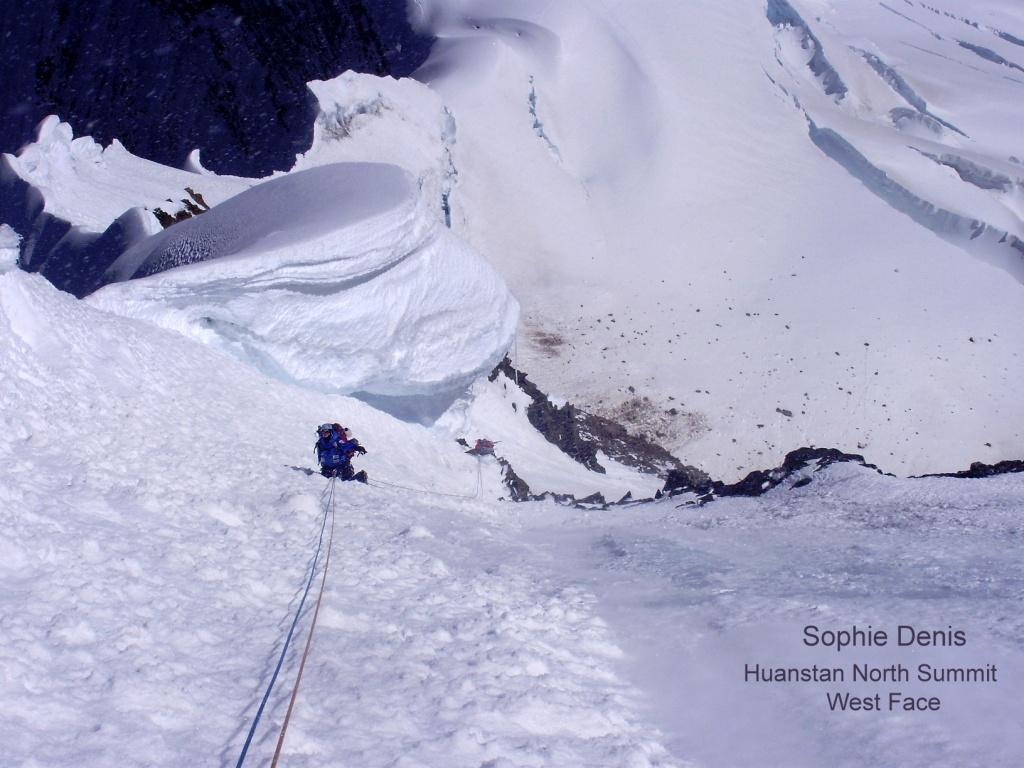
Sophie Denis and Beto Pinto at the top of the West face of Huantsan North Summit
Sunday, July 18, 2010
On our way to climb Huantsan

Huantsan Climb
- 7 - 10 days climb
- we will be 3 climbers : Beto, Mono, and Me
- sleeping : we will bivouac - no tent
- food: we will eat mainly dry food, ramen soups, and energy bars
- we will climb between 10-18h a day
Wednesday, June 23, 2010
Expedition REPORT
7 DAYS CLIMBING TRIP IN CENTRAL RANGE

Alpine Glow on the Central Range
Suiricocha, Manon Dos and Vicuñita is one of the peaks in the Central Range, located in Lima’s Region. Despite of the first ascend was in 1964 by a German expedition, this region of the Andeans remains in our days pretty remote and unexplored. The Central Range offers you nice mix climbing walls, and multi-pitches technical faces. This area is perfect experienced climbers who enjoy technical climbs in the 5000m altitude range.

Routes opened by Sophie Denis and Beto Pinto
SUIRICOCHA (5,495 m.a.s.l)

- Approach: We left San Mateo for the Rio Blanco to Paccha Lake. The next day at 8am, we carried our climbing gear and equipment up to the Moraine Camp (3 hours),
- Route: The 3rd day, we left the Moraine Camp at 3am to climb Suiricocha North Face. The approach was longer than expected, as we have to cross a hard ice glacier, fairly active, with numerous crevasses. Then to save some time, we start climbing the first 3 pitches of the face together in Assembly style. Snow getting loose at pitch 4th, we start climbing with protection around 6am. Then we enjoyed a nice hard snow from pitches 5th to 7th, which allow us to a set up a fast climbing pace. The first 2 pitches of the face have an angle ~ 60 º, the 5 following pitches are a little steeper ~70º. The wall finish by a steep section made of broken hard ice, lots of loose rocks and a little shelter with an angle > 80°. That very psychological last pitch is the most difficult part of the climb and it sets up the route difficulty level. We summit at 8:30. The view is stunning.
- Descent: We made 8 rappels for the same route. We were out of the glacier by noon and after a lunch break, we arrived at our camp at 3pm.
MANON DOS (5,500 m.a.s.l)

- West Face
- Mix Terrain with loose snow, big snow plates, few big horizontal crevasses. Angle up to 90 º. The poor snow condition makes the route very difficult (MD+)
- First ascent: June 4, 2010 by climbers Sophie Denis & Beto Pinto
- Name of the route: “Beyond Survival”
- Elevation: 800m from moraine camp (4,700 m.a.s.l), to the summit (5,500 m.a.s.l)
- Grade: MD+ 280m 60°- 70°- 80°- 90°
- Equipment: 2 rope (60m), 2 Ice axes, 4 Snow pickets, 3 ice screws, rock gear, 5 friends , 8 stoppers and 5 pitons.
- Time: 02 days
Climb quick sum up:
- Approach: After a rest day, we left the Moraine Camp at 3am on the 5th day to climb Manon Dos West Face. We left our climbing gear at the bottom of the glacier the previous day. The approaches consist in crossing a fairly long glacier made of hard ice with numerous crevasses. Those crevasses are relatively thin, so beside the stressful crevasse cracking/popping noise when walking on the glacier, this phase is pretty straightforward. Nevertheless, the lack of safe place to rest due to the possible rock falls and active crevasses terrain, make that phase a little long and tiring. Then you have to kick hard the ice to climb the bottom of the Moraine made of hard blue ice with lose rocks. Once you passed it, you will walk on a flat part (max angle of 30 º) to reach the bottom of the face. Watch out to the rock falls.
- Route: We start our first pitch at 5am by crossing a bergschrund, then face got steepen reaching rapidly an angle of 80º -90º. Good snow conditions deteriorate drastically as we found unexpected snow plates. That slow us down a lot as we have now to deal with high risk of avalanches. The 3rd pitch is even more difficult as we discover giant crevasses with very loose snow bridges. Snow and ice conditions were not really good to put descent anchors. We experienced as well small mushrooms which were hanging. But those were not a difficulty beside of they are avalanches’ sensitive. Once you pass the hedge of the top of face, it is a walk to the summit with an angle between 30 º to 60 º. We summit at 8:30am. The 2nd and 3rd pitches were really time consuming as unexpected hazard keeps popping up along the climb.
- Descent: We rappel the same route. To have enough snow pickets (2) for our next climb, our goal was leaving 2 snow pickets and 1 old ice crew behind us. To do so, we had to be creative. We used Bollard for the 2 first rappels as the snow was hard and slope angle appropriate. Then we used 2 snow pickets for the next 2 other rappels. For our last rappel, we put a piton in a nice rock block with good rock quality. Then, we down climbed to the bottom of the face, then to the bottom the Moraine. We arrived at the glacier ~11am, ice was still good, not too many pools. We were out of the glacier by noon and after a lunch break, we arrived at our camp at 3pm.
VICUÑITA (5,538 m.a.s.l)

- West Face
- Mix Terrain with loose and deep snow, snow plates, 2 big horizontal crevasses, loose rocks and channel made of rocks & hard ice. Angle up to 90º. Passing that channel required experience in mix climbing and makes the route very difficult (MD+)
- First ascent: June 6, 2010 by climbers Beto Pinto & Sophie Denis
- Name of the route: “Sacred Ayahuasca”
- Elevation: 838m from moraine camp (4,700 m.a.s.l), to the summit (5,538 m.a.s.l)
- Grade: MD+ 380m 60° - 90°- 70° - 60°
- Equipment: 2 rope (60m), 2 Ice axes, 2 Snow pickets, 3 ice screws, rock gear, 5 friends , 5 stoppers and 3 pitons
- Time: 02 days
Climb quick sum up:
- Approach: After a rest day, we left the Moraine Camp at 3am on the 6th day to climb Vicuñita West Face. The approach was consisting in crossing the moraine, made of lose rock and crossing a small glacier made of hard ice with obvious horizontal crevasses. This phase is pretty straight forward and should have been fast but Sophie was sick and had some difficulties of breathing. We arrive a the bottom of the face at 5am.
- Route: To safe time we climbed together in the Assembly style almost 2 pitches. Snow was loose; angle was up to 60 º for the last meters before reaching the bottom of channel. The rock was perfect to set a nice anchor. We start climbing the channel at 5:30am. Rock in the channel was a little loose but the hard ice was perfect to grab enough support / resistance to climb. It is a very enjoyable pitch made of pure mix climbing followed by a hard ice 90º section. Then, once you arrived at the top of the hedge of the face, you walk to the summit on a slope with an angle of 25 º to 45 º. Good snow condition. We noticed that the hanging mushroom had a big crack, so watch out.. We summit at 7:30am. Views are breath taking, and climbing the channel is real hard core climbing which makes you feel good. Paccha route: As we were feeling good, we decided to walk along the whole ridge to Paccha summit. (Snow melts pretty fast with the sun, so it seems better to be out of it by ~10am.)
- Descent: We descent Paccha via the normal route. We arrived at the bottom of the glacier ~10am, ice was hard. We got a lunch then we went down the Moraine to the base camp. We change base camp from Moraine Camp to Paccha lake base camp. We arrived at our camp at 1pm.

We are gpoing home happy - looking forward our next in July
Subscribe to:
Posts (Atom)